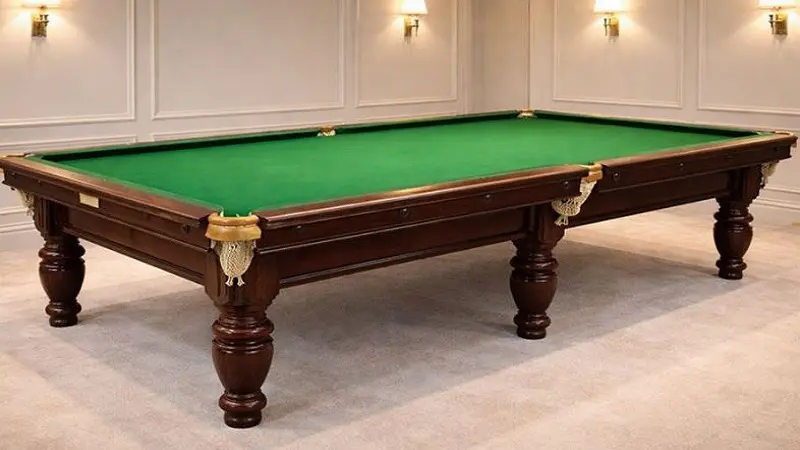
For players, the quality of a snooker table is felt immediately. The balls should roll cleanly, cushions should respond consistently and the table should remain level across the full playing area. That standard is not achieved by appearance alone. It comes from the materials used, the skill of the table maker and the care taken during installation.
A professional snooker table is made through precision joinery, heavy slate installation, cushion fitting, cloth stretching and detailed hand-finishing. While the finished table may look simple, its performance depends on every surface, joint, pocket and cushion being built to tight tolerances.
For anyone considering a bespoke or professional-grade table, Hamilton Billiards brings over 40 years’ experience in making, supplying and restoring handmade snooker, pool and billiards tables.
What makes a snooker table professional?
A professional snooker table is defined by its size, slate bed, level playing surface, cushion response, pocket accuracy and stability. The official rules published by the World Professional Billiards and Snooker Association set out the standard dimensions for snooker and English billiards tables.
A full-size table is commonly referred to as 12 ft x 6 ft, with the playing area sitting within the cushion faces. In metric terms, the official playing area is 11 ft 8½ in x 5 ft 10 in (3,569 mm x 1,778 mm), with a permitted tolerance. The real distinction, however, is whether the table has been built as a precision playing surface rather than simply as furniture.
Are professional snooker tables made in standard sizes?
Snooker tables are commonly made in standard sizes, but professional full-size tables are built to the recognised 12 ft x 6 ft format. Smaller standard sizes, often including 10 ft, 9 ft, 8 ft and 6 ft options, can be more practical for homes, schools, clubs and leisure spaces where a full-size table would leave too little cueing room.
A smaller table should still be built proportionally, with a stable frame, accurate slate bed, correctly fitted cushions and suitable pocket openings. Hamilton Billiards can help customers choose a size that suits the room. The best table is not simply the largest one available; it is the one that can be properly installed, levelled and played in the space.
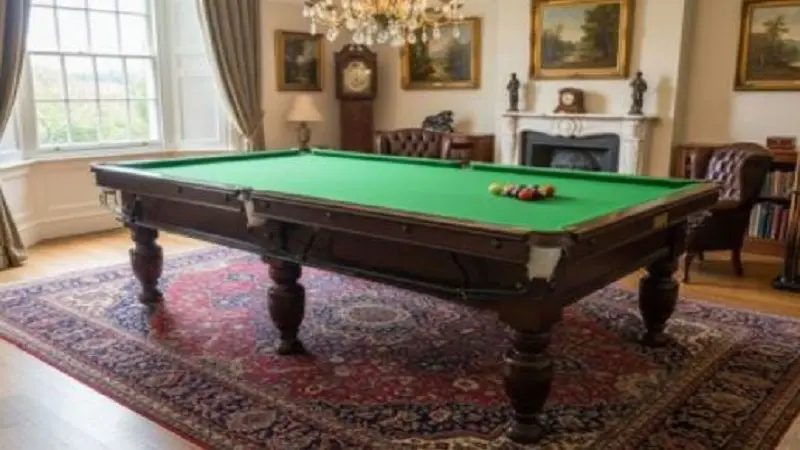
The process starts with design and specification
A professional snooker table begins with design decisions: table size, frame style, timber, finish, leg shape, pocket design, cloth colour and whether the table needs to suit a private home, club, hotel, school, office or leisure space.
For a bespoke table, the room must be assessed before manufacture begins. Cueing room, lighting, flooring strength and access for delivery all matter, especially for full-size tables because the slate sections are extremely heavy.
The maker will usually confirm the table size, room dimensions, finish, cloth, pocket style, access route and installation requirements so the table is shaped around the setting.
The frame is built for strength and stability
The frame is the structural foundation of the table. It must support the slate bed, absorb years of use and remain stable over time. If the frame flexes, twists or settles unevenly, the playing surface can lose accuracy.
Professional tables are usually built with strong hardwood or high-quality timber components. Traditional joinery methods create strength through fit, alignment and mechanical integrity. This work sits within a wider tradition of British joinery, represented by organisations such as the British Woodworking Federation
The slate bed creates the true playing surface
The slate bed is one of the most important parts of a professional snooker table. Slate is used because it can be machined flat, remains stable and provides the consistent surface needed for accurate ball roll.
On larger tables, the slate is usually supplied in multiple sections. Each section must be positioned, levelled and joined so the finished bed behaves like one continuous surface. Any unevenness, ridge or gap can affect the path of the ball.
The levelling process is painstaking. Installers adjust the slate using specialist tools, checking for tiny variations across the table. Once aligned, the slate joints are filled and finished so they cannot be felt through the cloth. A well-made table can still play badly if the slate is poorly installed.
Cushions and pocket openings shape the game
The cushions control how the balls rebound, so their profile, rubber quality and installation have a major effect on play. A professional table should offer predictable cushion response around the whole table.
Pocket openings are equally important. The cut of the pocket, the cushion curve and the fall into the pocket all influence how forgiving or severe the table feels. This is where table making becomes more than furniture production; the rails, cushions and pockets must be built for the behaviour of the game itself.
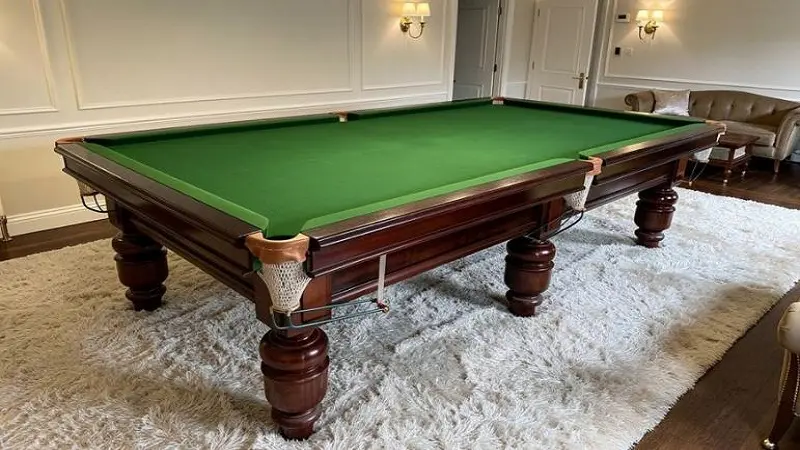
The cloth is stretched and finished by hand
The cloth is the surface the player interacts with most directly. It affects speed, control, spin and overall feel. Professional snooker cloth must be fitted under the correct tension. If it is too loose or stretched poorly, it can slow the table, create imperfections or leave visible marks.
On traditional napped cloth, the direction of the nap also matters because it influences ball behaviour. The cloth is laid over the slate, stretched evenly and secured around the cushion rails and pockets. A good cloth fitting should appear almost invisible: no ripples, awkward folds or uneven tension.
Final levelling and installation complete the table
Once the frame, slate, cushions, pockets and cloth are in place, the table must be checked again. Final levelling is essential because even small movements during assembly can affect the surface.
Installers may test the table with precision levels and by rolling balls across different areas. The aim is to ensure the ball travels smoothly and naturally, without drifting because of uneven slate or floor movement. Lighting and room layout may also be reviewed because both affect play.
Why handmade construction still matters
Modern machinery can help with accuracy, but a professional snooker table still relies on judgement, touch and experience. Timber has natural variation, slate needs careful handling and cloth tension is felt as much as measured. The sport’s long history, outlined by organisations such as World Snooker Tour is part of that appeal.
That is why handmade construction remains valuable. It allows the table to be built as both a precision sports surface and a long-lasting piece of furniture. For private homes, clubs and hospitality spaces, the table has to perform properly while looking at home in the room.
Final thoughts
A professional snooker table is made through careful design, strong frame construction, precision slate installation, accurate cushion fitting, expert cloth stretching and detailed final levelling. Every stage affects how the table plays.
For business owners, clubs and homeowners, the lesson is simple: a snooker table should not be judged by looks alone. Its real quality is in the stability of the frame, the accuracy of the slate bed and the response of the cushions.

When made and installed properly, a snooker table can last for decades. With a specialist maker such as Hamilton Billiards, the result is not simply a table, but a carefully engineered playing surface built around the room, the user and the game itself. See more