Nobody likes getting a letter from HMRC. You open it, your stomach drops a bit, and before you’ve finished the first paragraph you’re mentally auditing every claim you made last year. (Been there? Most people have.) A lot of the folks who end up on the phone to tax investigation advisors have spent days stewing like that. And here’s the irony: the label HMRC puts on the enquiry, aspect or full, only says how much of your return they want to look at. It tells you next to nothing about how it’ll turn out.
What Is an HMRC Aspect Enquiry?
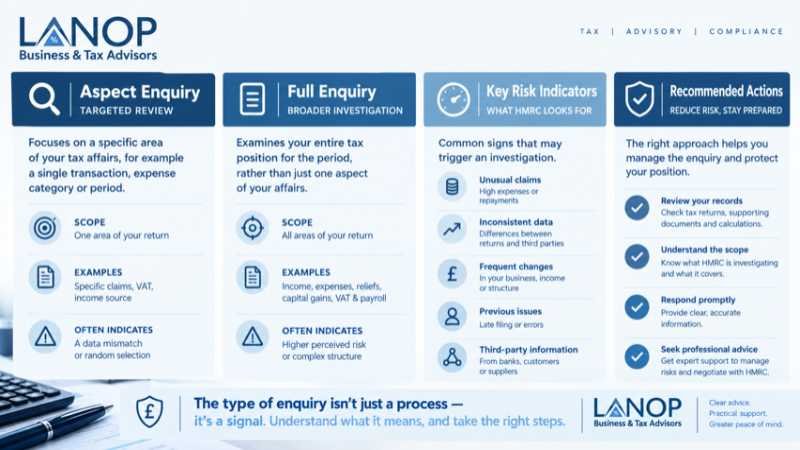
Suppose the expenditures of a café owner appear excessive compared to those of other similar businesses. Another example could be a property owner whose rental income differs from the amount stated by the letting agent. In this instance, HMRC can select this data point and request clarification on that, and that’s all for the time being. This is an aspect inquiry.
We shouldn’t confuse “narrow” with “easy”. The queries can still be rather detailed, and, if one’s responses give rise to some anomalies, the tax authority can continue asking questions.
What Is a Full HMRC Enquiry?
A full enquiry is a real full-word phrase. It implies that HMRC checks the entire return in detail, requesting documents such as accounts, bookkeeping documents, bank records, invoices.
There is a good chance you hear “full” and immediately think that you made some mistakes or that HMRC found something wrong. This is usually not the case; HMRC wants to get information at a broader level.
Aspect Enquiry vs Full Enquiry: What Is the Difference?
It comes down to scope. One starts small, the other starts big. The table shows what that means in practice.
| Area | Aspect enquiry | Full enquiry |
| Main focus | One or more specific issues | A broader examination of the return |
| Scope | Usually narrower at the outset | Usually wider from the outset |
| Records requested | Mainly those tied to the issues under review | Potentially records supporting several areas |
| Possible findings | May raise questions about related issues | May identify issues across the return |
The table doesn’t say how any of this ends, and that’s deliberate. Either kind can close with nothing to pay, and either can close with a bill. Worth knowing, too, that “aspect” and “full” are HMRC’s internal shorthand, not legal categories. What your letter actually asks is the thing to study.
Does an Aspect Enquiry Indicate a Lower Risk?
Not necessarily. The harm caused by a single tight question on a huge poorly documented object may outweigh the benefits of a wide spectrum review with a negative outcome. It is not the question itself, but what it carries behind it that scores.
Could an Aspect Enquiry Become a Full Enquiry?
It could. Let’s say that HMRC questions your mileage claims, and when you are pulling the logbook you discover that VAT calculations did not match as well. Now you have to respond to a second question. However, it does not have to be this way. If you give proper answers and provide sufficient backup documents, everything will stay at the aspect inquiry level.
Does a Full Enquiry Indicate That Fraud is Suspected?
No. Enquiry means checking the return. Fraud is a separate conclusion made by the HMRC. Thus do not get carried away with thoughts about a worst-case development of events that may happen at 2 am. Just provide honest and exact responses.
What to do If you Receive an HMRC Letter?
The first step to take is to read the letter. Analyze minutely, noting the tax year and other details before doing anything. When checking the letter, pay attention to the following points: the name of the sender, the subject, when the letter should be answered and what answer it expects.
Once you are aware of everything, it is important to gather all the necessary documents and write down which documents are needed. You have to check whether they are in your possession. The first step is making sure that everything is in order at your end before receiving any claims from HMRC. If something is not right, do not rush or destroy any evidence regarding it.
When writing your reply, it is crucial to provide an answer not more than the necessary details. The more straightforward your answer is, the more chances you have of avoiding penalties from HMRC.
What to Expect if a Mistake is Made?
This is what everyone wants to know. The truth is that there is no definitive answer to this question; several factors will play a role in determining the outcome, such as what the tax
What to Do If You Believe HMRC is Wrong?
You have a right to contest through statutory review, appeal or alternate dispute resolution. Whichever method you choose, you must bear in mind that there is a deadline for your action. If you cannot pay, contact HMRC and ask for a payment arrangement. You must remember that a payment arrangement is different from an agreement on the matter.
What is the Time Limit for HMRC Tax Investigations?
Contrary to popular belief, the tax investigation does not go on indefinitely. The time limit for a Self Assessment tax investigation is one year from the filing date. Older tax years are subject to different limits which allows for longer tax investigations in cases with negligence or intentional errors. All in all, the investigation lasts as long as there are questions to be answered and you will need to keep a record of all your communication with HMRC.
When Should You Employ Specialist Tax Investigation Advisors?
Not every case calls for their involvement. An isolated query of this type might be successfully resolved with the help of your own accountant – and this would be entirely reasonable. However, it is appropriate to seek the assistance of specialists if:
- the question from HMRC is technical or relates to a number of taxes
- your records leave much to be desired or the figures do not have much in common
- you and HMRC interpret the regulations differently
- it has been mentioned that penalties may be imposed or fraud may be suspected
What exactly does a specialist do? They go through the letter, identify what HMRC needs, process your records, write the response to the letter. Once they are given the authority to act on your behalf, they communicate with HMRC and let you know if it makes sense to appeal the decision.
Frequently Asked Questions
Is it true that an enquiry is less intrusive than an investigation?
Essentially. In terms of expense, not so much. Sometimes you can spend far more answering one question concerning a limited sum than on a continuous investigation that results in no action taken.
Is it possible for HMRC to extend its enquiry in the course of time?
Yes, provided that your answers reveal new issues. It is not guaranteed, though, and if you provide clear and reasonable explanations, your enquiries can be limited.
Does receiving the letter mean that you have been found guilty?
No. Some returns are based on a risk-related factor, while the others are selected because a single figure has to be accounted for. Only receiving the letter is too vague an indicator to be of use.
Is it possible to do without using the services of an accountant?
Yes, if there is just one figure with elaborated receipts. The situation changes dramatically if you have a few kinds of tax, as well as more than just a minor amount; then hiring an experienced accountant is essential.
Would an honest mistake still cost me a penalty?
It might. HMRC asks whether the error was careless or deliberate, and whether you had a reasonable excuse, so the story behind the mistake counts as much as the mistake itself.
Conclusion
The difference between aspect inquiries and full inquiries is in the nature of their inquiry. The two have no bearing at all on guilt.
Be clear about your issues and your records, finish on time and get advice while the situation hasn’t escalated. If a letter has just come and you are confused about your situation, contact Lanop Business & Tax Advisors who can give you advice on possible actions through the company’s HMRC tax investigations service. Start this evening by rereading the letter and marking the deadline on the paper you will see tomorrow. See more